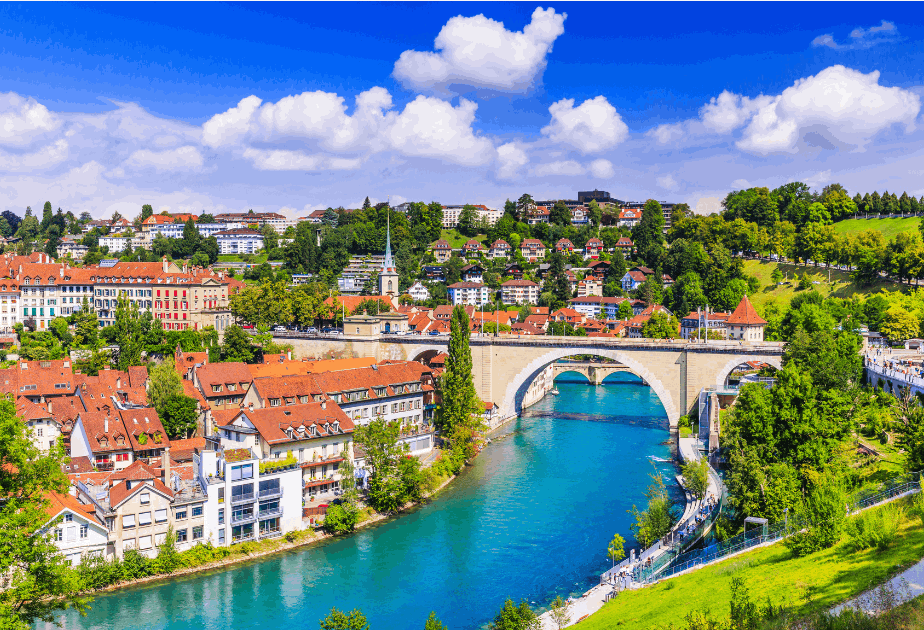
Switzerland is a small country located in the heart of Western Europe, and sharing borders with neighboring Germany, Austria, the Principality of Liechtenstein, Italy and France. There are now approximately 7.7 million people living in Switzerland, speaking four official languages: German, French, Italian and Romansh. A mountainous landscape: 60% of the Swiss territory is occupied by the Alps, a great mountain range stretching circa one thousand kilometers from Austria to France, that offer more than 80 peaks above 4000 meters. A prosperous economy
Education in Switzerland is characterized by a high standard of quality, a diverse range of programs, and a strong emphasis on research and innovation. The Swiss education system is known for its flexibility and the close collaboration between academic institutions and the business sector.
Switzerland's multicultural environment attracts students from around the world, contributing to a diverse and enriching academic experience. The key areas for Swiss exports are high-technology in general including pharmaceuticals, biotechnology, micro and nanotechnology, environmental technologies, as well as finance, design, luxury and hospitality. Environment and quality of life: a well-preserved environment easily accessible by public transport, safe cities, and excellent infrastructures make living in Switzerland very pleasant, and explain why the Global Ranking of Cities with a High Quality of Life ranks three Swiss cities among the top ten (Mercer's 2011 Quality of Living Survey). High diversity of cultures and languages, open access to students, very low student fees, highly international student cohorts and staff, as well as access to international networks and programs and tight links to academic research and industry, are the major strengths of the Swiss Higher Education System.
Switzerland offers a very dynamic, conducive and competitive education and research landscape, as testified by 27 Nobel Prize winners from 1901 to 2002. The first Swiss University was founded in 1460 in Basel and today the country offers outstanding higher education in the Universities and Institutes of Technology, in the more professionally-oriented University of applied sciences and in the University of teaching education. There are also a few more University level institutions that are considered public institutions of higher education.
Switzerland has several world-renowned universities. ETH Zurich and the University of Zurich are highly regarded for their contributions to science and technology. The University of Geneva and the University of Lausanne are prominent in the humanities and social sciences.
UAS focus on providing practical and industry-oriented education. They offer Bachelor's and Master's degrees and often include internships or work placements.
Many programs at Swiss universities are offered in English, particularly at the Master's and Ph.D. levels. This makes Switzerland an attractive destination for international students.
Switzerland has a well-developed dual education system that combines classroom learning with practical, on-the-job training. This system is particularly prominent in vocational education.
Swiss universities, the Swiss government, and various private organizations offer scholarships to both Swiss and international students.
Admission requirements differ between universities and programs. Generally, applicants need to provide proof of previous education, language proficiency, and may need to pass an entrance examination. Swiss higher education institutions are subject to quality assurance measures. The Swiss Accreditation Council ensures the quality of programs and institutions.
Free AI Website Creator